Chasing documents
Why a missing document is not a review point, how the chase list is built, and what to send the client.
A build produces two kinds of output that people constantly merge, and should not.
| Review point | Chase | |
|---|---|---|
| What it is | A judgement the AI made | A document that is absent |
| Where it shows | Against the workpaper line | The Awaiting panel |
| What you do | Reply to it, or ignore it | Email the client |
| Who resolves it | You | Them |
"This looks like a private-use apportionment" is a review point. "There is no June bank statement" is a chase. Putting the second in your review queue means sitting on a task you cannot complete.
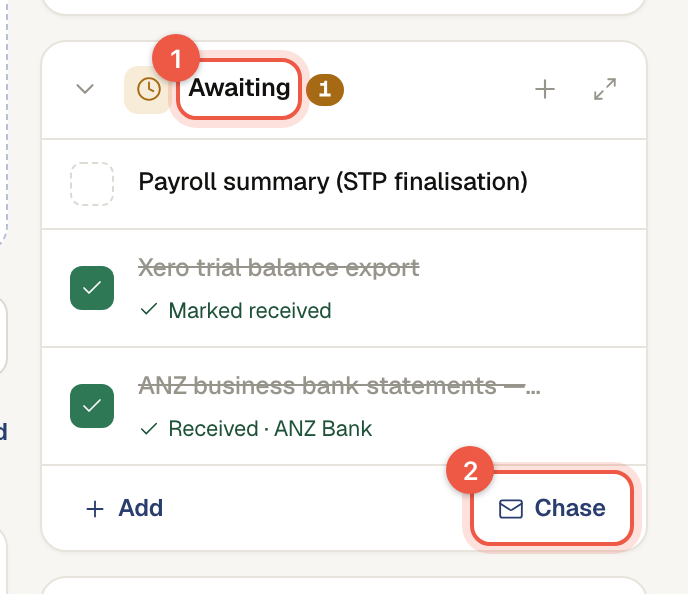
The Awaiting panel is the whole list, and it keeps what has already arrived struck through rather than deleting it — so "have we asked for this yet" has an answer after the fact.
How the chase list is built
Not by counting files. A chase line has an identity — what kind of document, which period, which instance — so twelve monthly BAS is not "BAS: 12 uploaded" but a period with gaps in it. A missing quarter is a gap in a range, and that is how it is reported.
Sending it
Chase lines become draft emails. They are drafts on purpose: what you can reasonably ask a client for, and in what tone, is not something to automate at send-time.
Chases do not block a build
You can build a working paper with documents outstanding, and often should — the result tells you what the gaps actually cost. What you cannot do is treat that build as final.
The case model
A case is one client for one financial year. What that constraint buys you, how a case moves through its stages, and how last year's case seeds this year's.
Reading the workbook
What is in a delivered working paper, how a figure traces back to the document it came from, and what the delivery gate checked before you saw it.